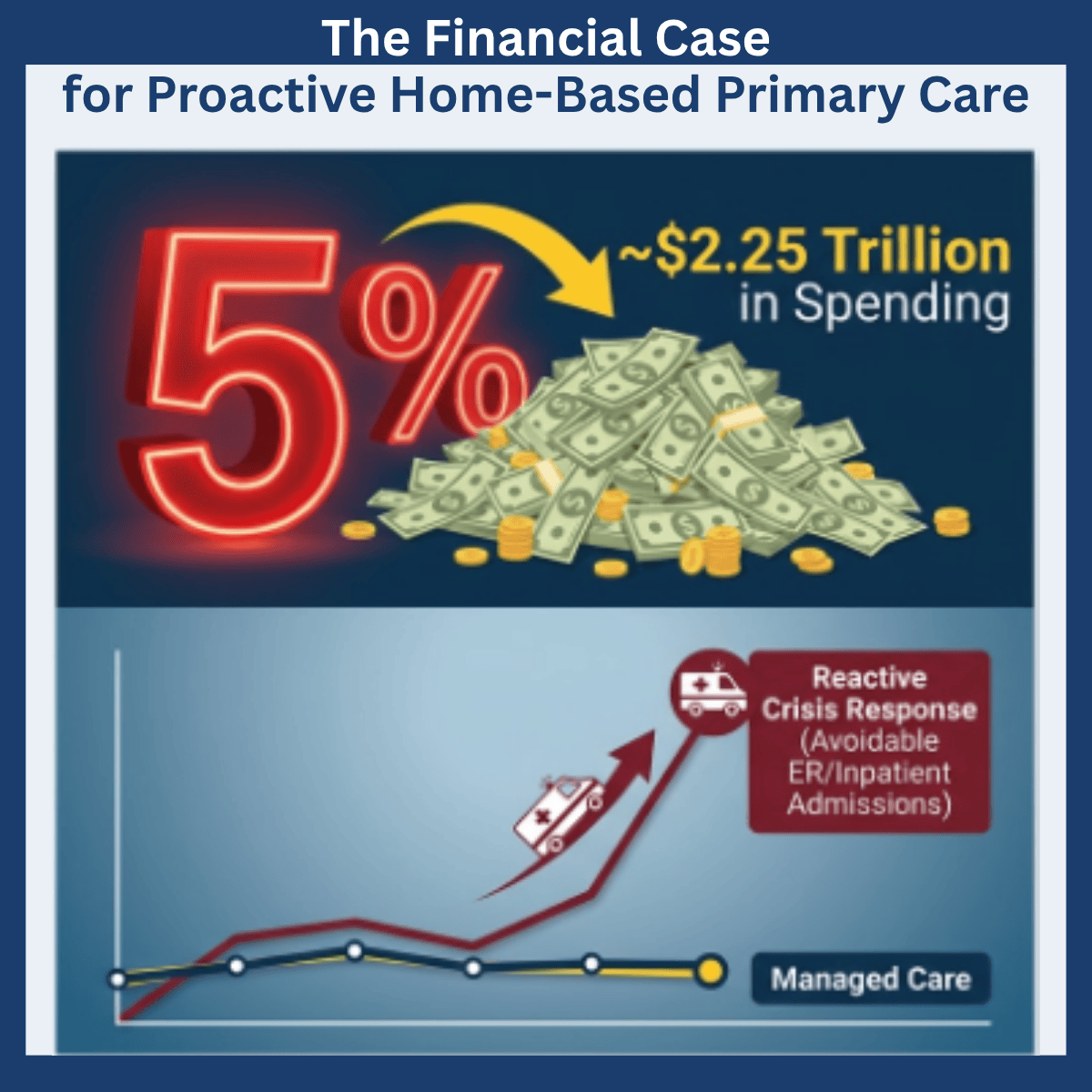
For assisted living operators, payers, and healthcare systems managing high-risk populations, the math on reactive care is unsustainable. Just five percent of patients account for roughly half of all U.S. healthcare spending—totaling an estimated $2.25 trillion. A disproportionate share of that spending flows through avoidable emergency department visits and preventable hospital admissions that signal breakdowns in chronic disease management, care coordination, and early intervention.
Artificial intelligence is changing the operational calculus. Home-based primary care platforms that integrate AI-driven remote patient monitoring with structured clinical workflows make it possible to detect deterioration earlier, respond faster, and keep high-risk patients stable outside of high-cost care settings.
DigitalDoctors@Home (DD@H) is built on exactly this model. In this article, we break down how AI functions as a clinical tool in home-based primary care, how it integrates with human oversight to produce consistent outcomes, and what that means for the operators, payers, and clinical teams responsible for the most vulnerable patients in their networks.
The Problem with Reactive, Facility-Based Models
For decades, healthcare infrastructure was built on the assumption that patients would come to the system. That assumption holds when patients are mobile, engaged, and have few competing barriers. For medically complex seniors and high-risk adults managing multiple chronic conditions, it rarely does. Missed follow-ups, transportation barriers, and fragmented communication between care settings mean that small changes—a subtle shift in respiratory rate, a modest weight gain—go undetected until they escalate into an avoidable hospital admission or ED visit.
Assisted living operators know this pattern well. So do the payers funding it. The system responds to crises rather than preventing them—driving up cost and risk for everyone involved. The question is not whether proactive intervention has value; it is whether a scalable, operationally consistent model exists to deliver it.
The DD@H Model: AI as a Clinical Infrastructure Layer
DigitalDoctors@Home combines AI-powered remote patient monitoring with a Virtual Patient Care Center and a high-touch clinical team to create a repeatable system for managing high-risk patients at home. The model is built around Total Care Management—evaluating not just vital signs, but sleep patterns, mobility, nutritional access, and environmental factors that affect clinical outcomes.
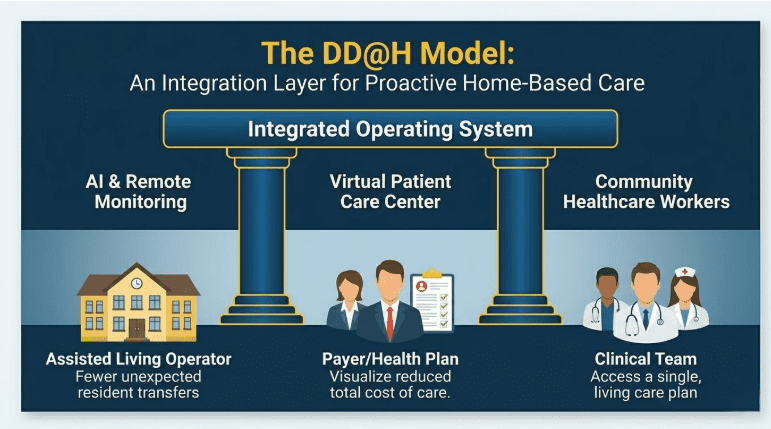
Patients receive user-friendly connected devices that continuously track blood pressure, pulse, respiratory rate, and blood glucose. Data streams to DD@H’s Virtual Patient Care Center, where AI analyzes trends, flags deviations from each patient’s established baseline, and surfaces alerts for clinical review—without requiring technical fluency from the patient. This is not device distribution. It is a monitored clinical infrastructure with documented escalation pathways.
Three Questions AI System Answers
-
1. How is clinical deterioration identified before it becomes a crisis?
Standard vital sign thresholds miss the early warning signals that matter most in chronic disease management. DD@H’s AI continuously evaluates trends against each patient’s individual baseline—not population averages—to identify meaningful deviations weeks before symptoms present.
Consider a patient managing congestive heart failure. A two-pound weight increase over three days, combined with a slight upward shift in respiratory rate, is a recognized pattern of early fluid retention. The AI flags it. The clinical team responds. Medication is adjusted. A hospitalization is avoided. That is the operational difference between reactive care and proactive management.

-
2. Who Responds, and How Fast?
Every alert generated by the AI has a defined clinical owner and a documented response pathway. DD@H’s licensed providers review AI-generated insights within the Virtual Patient Care Center workflow and determine the appropriate intervention—whether that is a same-day call, a virtual visit, or escalation to in-person care.
Urgent signals route immediately through an on-call pathway. Non-urgent but clinically significant changes receive same-day or next-business-day outreach based on severity. Operators and care teams have a single point of contact and know exactly what happens next.
-
3. How does the system keep care teams aligned across settings?
Fragmented communication between primary care physicians, specialists, facility staff, and families is one of the primary drivers of avoidable utilization. DD@H’s care coordination model addresses this directly. A living care plan—continuously updated based on monitoring data and clinical decisions—is shared across the patient’s care network. Documented interventions, medication changes, and care transitions are logged so the next clinician or operator is not starting from scratch.
Weekly check-in calls, monthly virtual visits, and regular in-person assessments ensure that the care plan reflects the patient’s current condition—not what was documented at the last office visit.
The Financial Case for Proactive Home-Based Primary Care
The financial benefits of preventing avoidable utilization are clear and measurable. Every prevented emergency room visit represents approximately $3,000 in avoided cost to the healthcare system. Each avoided inpatient admission reduces costs by an estimated $17,500. Across a managed population of hundreds of patients, the aggregate impact is significant—and the DD@H model is designed to demonstrate that impact with documented outcomes.
For payers evaluating total cost of care, this model directly targets the highest-cost utilization driven by the highest-risk members. For operators, it reduces surprise transfers, smooths care transitions, and supports census stability.
Community Healthcare Workers:
Operational Infrastructure at the Last Mile
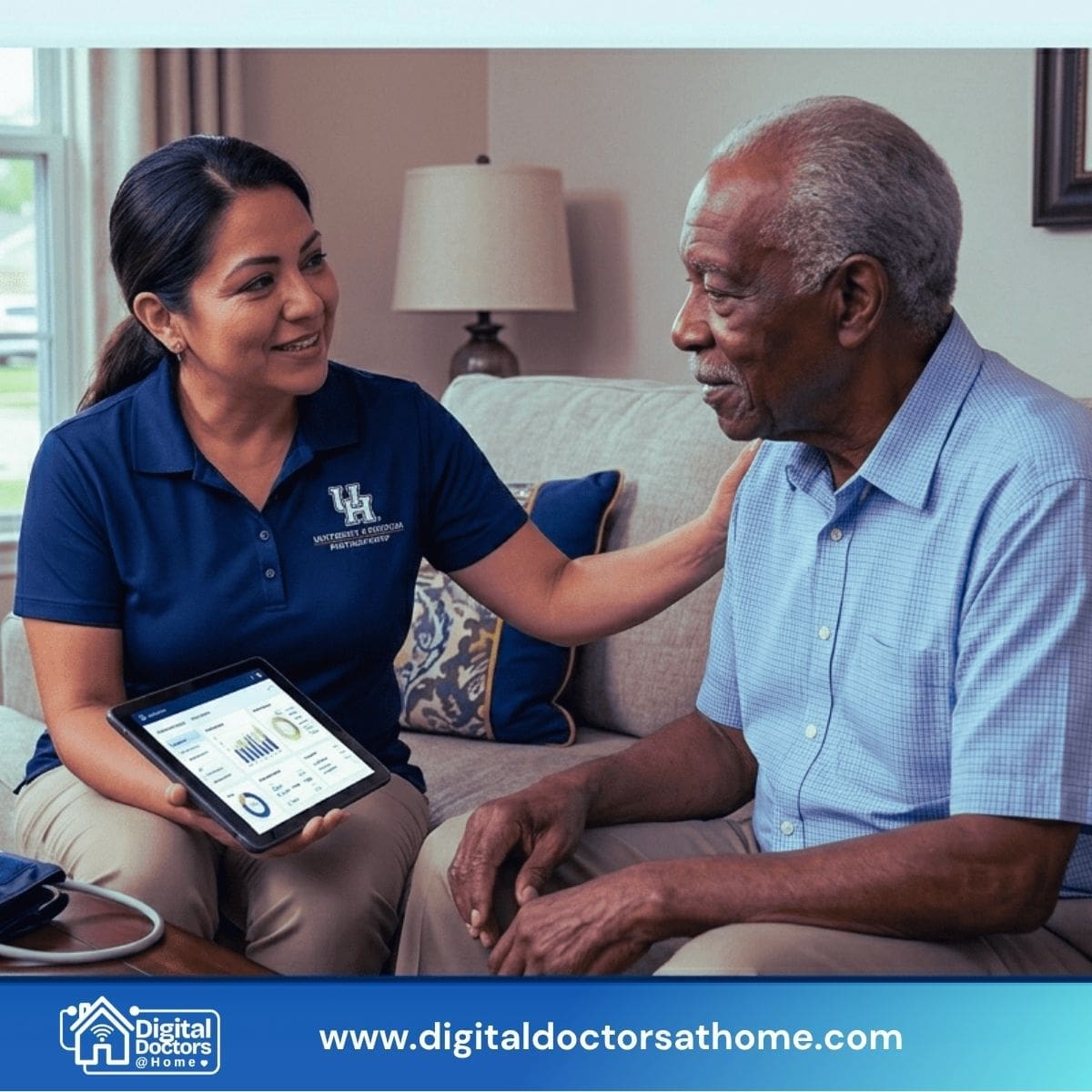
Clinical tools alone cannot close the gap between a documented care plan and what actually happens in a patient’s daily life. DD@H addresses this through a formal partnership with the University of Houston, which trains community members to become certified Community Healthcare Workers (CHWs).
These certified professionals are embedded in the communities they serve. They understand local resources, cultural context, and the practical realities that affect medication adherence, nutrition, and follow-through on care plans. They surface the early signals—confusion, missed medications, changes in appetite or mobility—that do not show up in monitoring data but predict deterioration just as reliably.
For operators and care networks, CHWs represent a scalable, cost-effective layer of continuous oversight that complements remote monitoring and clinical review—without adding burden to existing staff.
What This Means for Your Organization
For Assisted Living Operators
Fewer surprise transfers through earlier detection and cleaner escalation pathways. A predictable response workflow for clinical change. Reduced liability from unmanaged deterioration.
The DD@H model supports facilities by clarifying what changes to report, creating a single workflow for who to call, and tightening the feedback loop so no one is left guessing.
For Clinical Teams
A coordinated support system that extends visibility between visits, closes care gaps before they widen, and keeps the care plan current across all touchpoints.
Patients and their families can feel confident that their PCP, specialists, on-site care staff, and care coordinators share a current picture of their health status and are ready to respond when needed.
For Payers
A structured, measurable model for reducing avoidable ED visits and inpatient admissions in your highest-cost members.
Documented interventions and outcomes that support value-based contract conversations.
A Model Built to Integrate, Not Replace
Proactive home-based primary care is most effective when it is treated as a consistent operating system: a living care plan, structured outreach, early risk visibility, and clean coordination loops. DigitalDoctors@Home is built to integrate with existing care structures, not to replace them.
By combining advanced AI, seamless remote monitoring, and Community Healthcare Workers embedded in the communities they serve, the DD@H model is designed to reduce avoidable utilization and improve outcomes for the most medically complex patients in your network.
Learn More
Contact DigitalDoctors@Home to learn how the DD@H model fits your organization and the populations you serve.


