Summary -Most care plans look great on paper. But real outcomes are shaped by what happens in the days between visits, when medications run out, transportation falls through, symptoms change gradually, and daily routines don’t match what the care plan assumes.
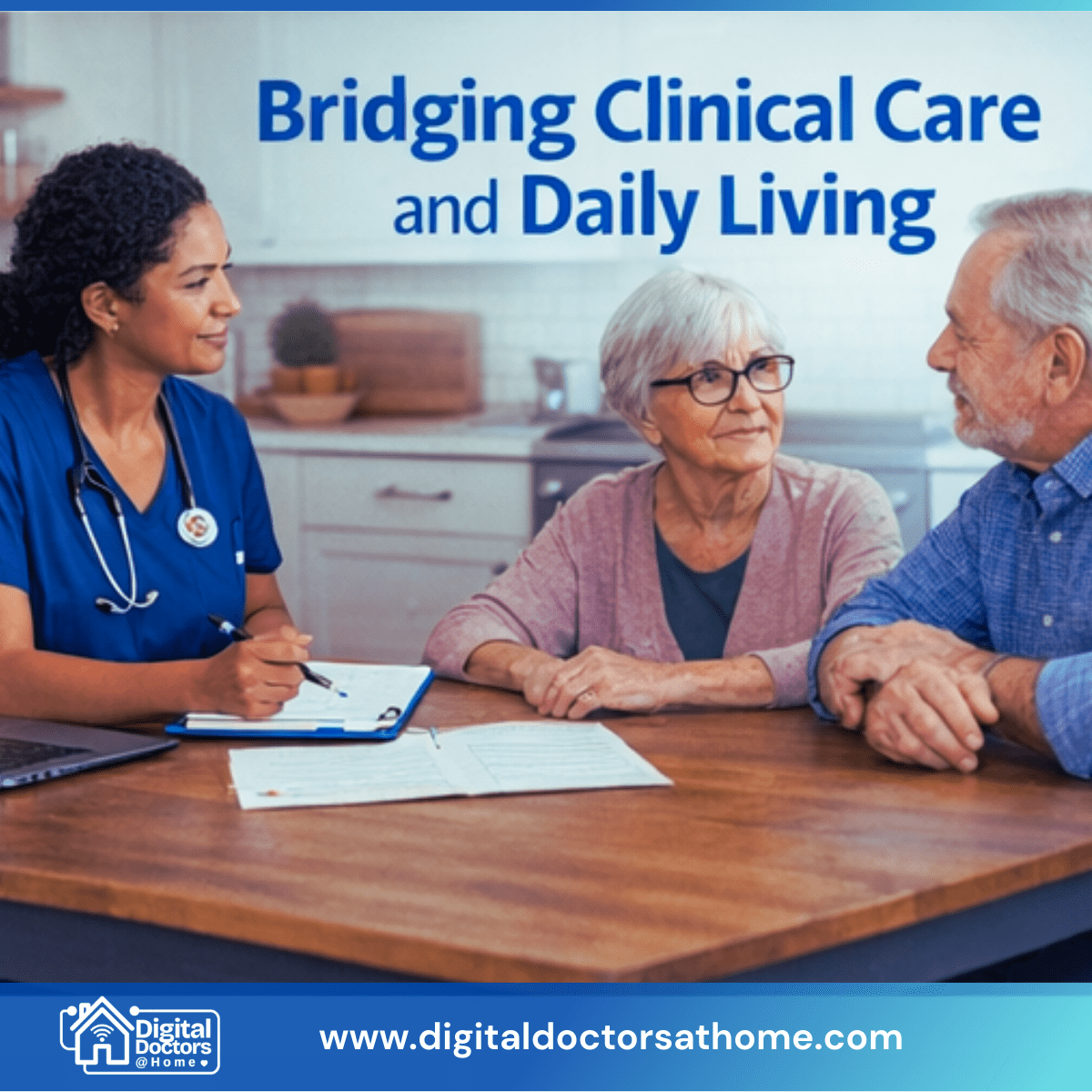
That “in-between” space is where Community Healthcare Workers (CHWs) make a measurable difference. CHWs act as trusted connectors between people and the health and social services they need, helping turn clinical recommendations into practical next steps in daily life.
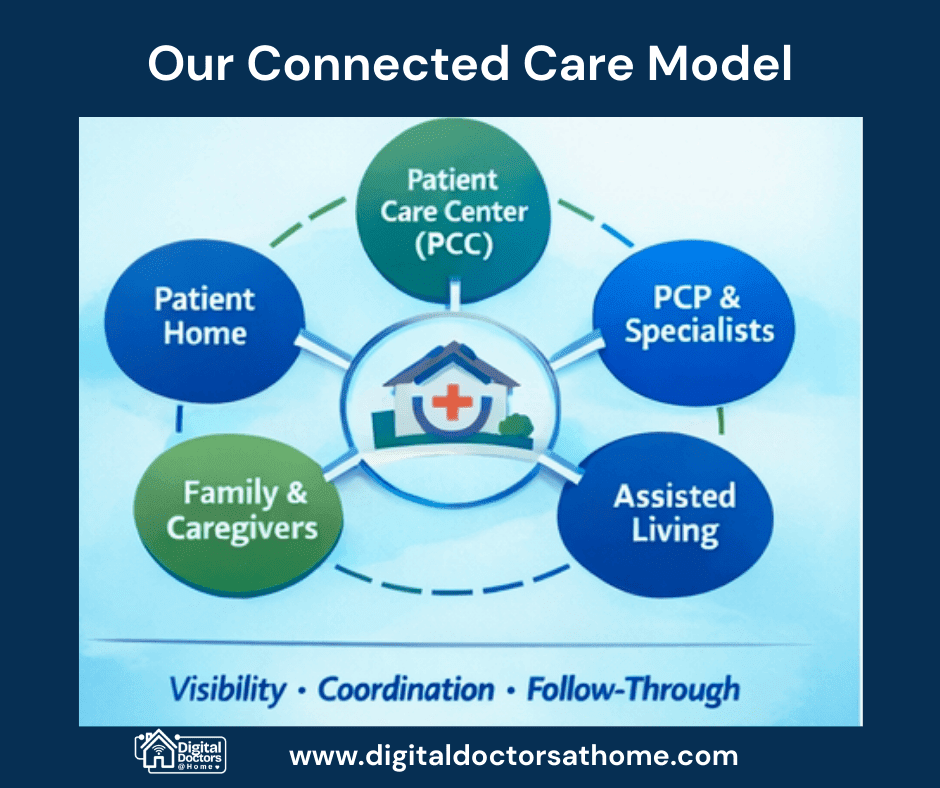
At DigitalDoctors@Home, this bridging role is a vital part of our operating model. Our virtual Patient Care Center (PCC) monitors data and coordinates care, alongside a community-based clinical team that includes Community Healthcare Workers who provide high-touch support in patients’ homes and communities.
What is a Community Health Worker?
A Community Health Worker is commonly defined as a frontline public health worker who is a trusted member of, or has a close understanding of, the community served. That trust positions CHWs to serve as a liaison between health/social services and the community, improving access and helping people navigate systems that can otherwise be difficult to use.
In plain terms: CHWs help close the gap between “what the clinician recommends” and “what the patient can realistically do.”
CHWs do not replace clinicians. They extend the reach of clinical care into daily life, especially for seniors, medically complex patients, and people facing barriers related to transportation, food access, health literacy, technology, or caregiver support.
Community Health Care Workers' Daily Activities
CHWs wear a lot of hats. The way they act as a “bridge” usually shows up in the following practical ways:
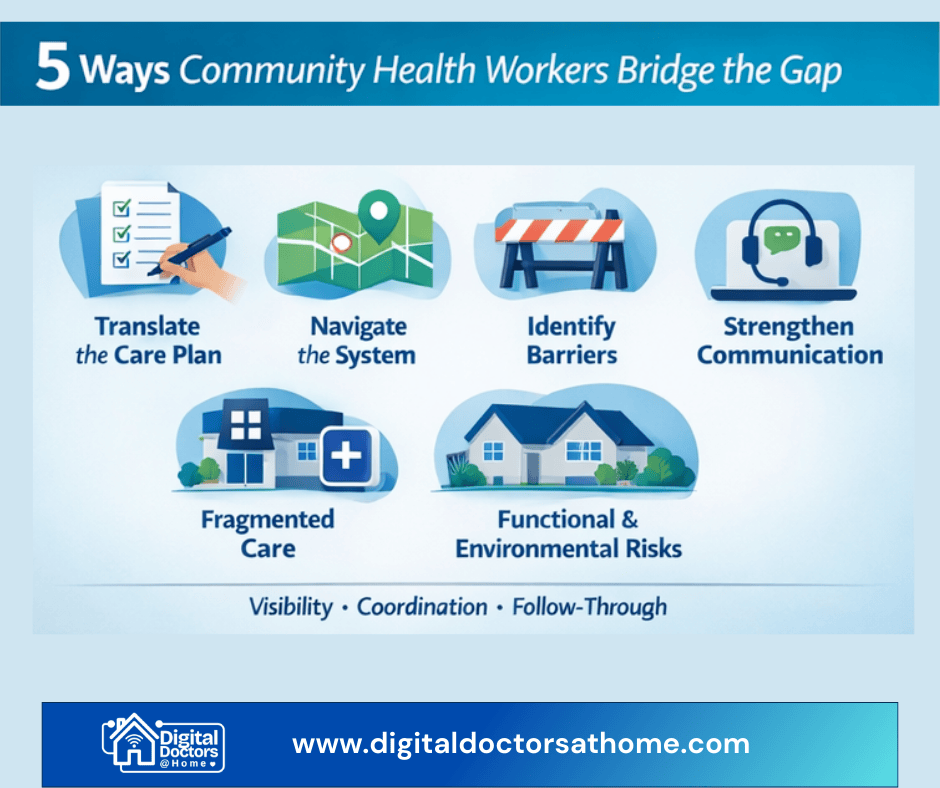
They translate the care plan into doable steps
Clinical instructions are often delivered quickly and under stress, especially at discharge or after a medication change. CHWs help patients and caregivers understand what the plan means in real life: what to do today, what to watch for, and when to call for help.
They navigate the system so patients don’t get stuck
Appointments, referrals, transportation, pharmacy pick-ups, benefits, and paperwork can be the difference between stability and avoidable escalation. CHWs help people connect to the right services and remove friction that causes delays.
They identify barriers that clinicians don’t see in the exam room
A plan may assume a patient has food at home, a safe place to recover, reliable transportation, or someone who can help. CHWs find out what’s actually happening, then route that information back to the care team so the plan can be adjusted.
They strengthen communication between everyone involved
In home-based care, “everyone” often includes the patient, family, assisted living staff, PCP, specialists, and care coordinators. CHWs help keep the loop closed so tasks don’t fall into the “someone else is handling it” gap.
They support telehealth and technology use when needed
When telehealth is part of the care plan, CHWs can help patients feel comfortable using it, learn basic tech steps, and troubleshoot access issues, which reduces missed connections.
Why This Daily-Living Bridge Matters Most
For Seniors & Medically Complex Patients
The gap between clinic care and daily living is bigger when patients have:
-
multiple chronic conditions & Complex Routines
Medications, diet guidance, monitoring, mobility, and follow-up schedules create a lot of moving parts.
-
Fragmented Care Across Providers & Settings
Primary care and specialists may not have real-time visibility into what’s happening at home or in an assisted living setting.
-
Functional or Environmental Risks
Changes in mobility, cognition, nutrition, or caregiver support can quietly increase risk—long before a vital sign crosses an “urgent” threshold.
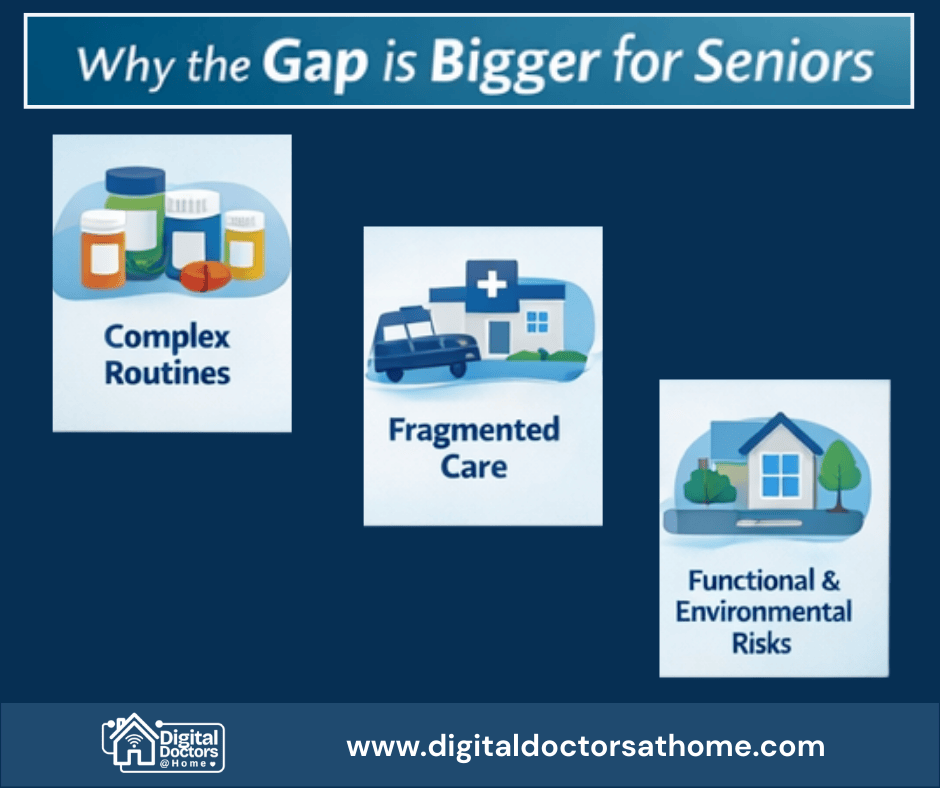
CHWs help bring those realities into view, so care teams can respond earlier, not later.
How the DigitalDoctors@Home Model Brings This to Life
DigitalDoctors@Home uses a “hub-and-spoke” approach that includes: a virtual Patient Care Center (PCC) that coordinates care and monitors data, while community-based clinicians and Community Healthcare Workers provide direct, high-touch support in the home and community.
Here’s what that looks like in a practical workflow.
1) Detect: Identify risk signals and real-world barriers early
DD@H’s PCC monitors data, identify trends, and coordinate care. CHWs add another crucial layer: they bring “daily living” signals to the surface, like missed medications, reduced appetite, increased confusion, caregiver strain, or a change in mobility, that may not show up clearly in a remote reading.
2) Escalate: Route concerns through a clear pathway
When a concern is identified, someone must own the next step, and our PCC model is designed to support that. Concerns will be triaged, documented, and escalated to the appropriate clinical role (nursing, advanced practice, or physician) based on urgency.
CHWs help by ensuring the concern is captured with context (what changed, when, what else is happening at home), and by supporting the communication loop so nothing stalls.
3) Coordinate: Ensure follow-through across the care team
Care coordination is where many well-intended plans fail, especially across PCP/specialists/facility/family. DigitalDoctors@Home provide coordinated, team-based care delivered through the PCC and community team. CHWs contribute by helping patients access resources, follow through on next steps, and stay connected to the care plan.
What This Looks Like in Real Life
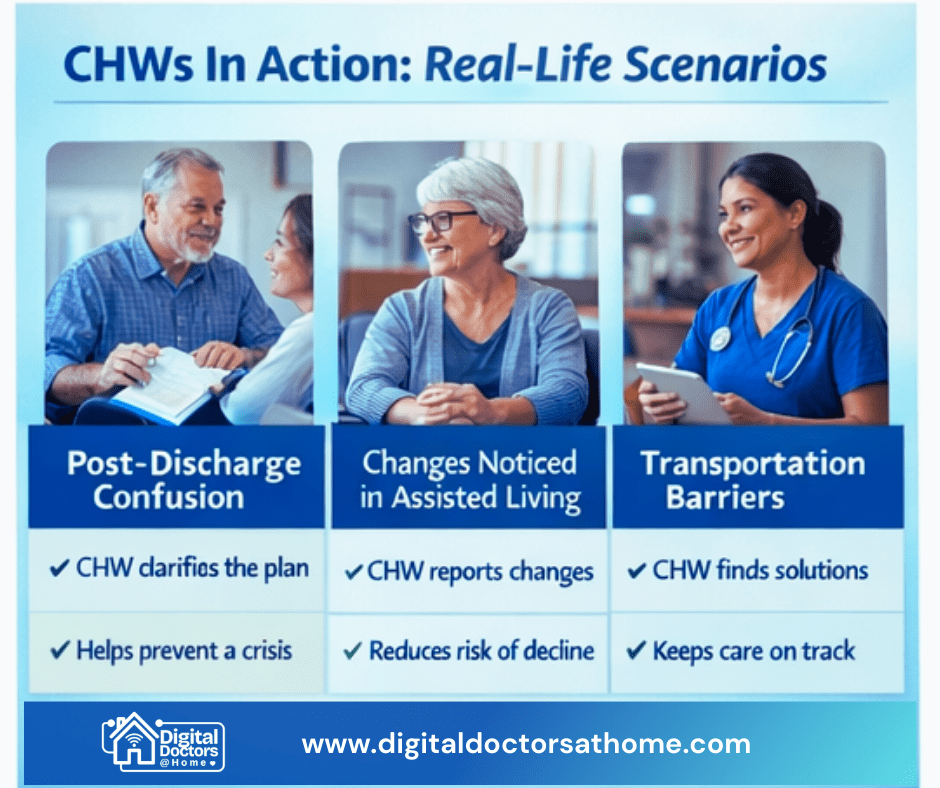
Here are three simplified examples of how CHWs bridge clinical care and daily living in a coordinated model.
Common misconceptions about CHWs
“CHWs are the same as nurses.”
CHWs and nurses can work closely, but their roles are different. CHWs are often focused on barriers, navigation, trust-building, and follow-through across health and social services.
“CHWs replace clinical care.”
CHWs extend the reach of clinical care. They do not diagnose or replace licensed clinicians.
“CHWs are only about social services.”
Social needs often affect health outcomes, so CHW work frequently includes connecting patients to resources. But the purpose is care continuity so that care plans work in the real world.
Why CHWs Can Be A Force Multiplier in Assisted Living
Assisted living teams are already doing a lot: supporting daily living, communicating with families, and coordinating with outside providers. CHWs can strengthen assisted living operations by:
- reducing communication gaps between facility, family, and clinicians
- helping ensure follow-through after care changes
- supporting earlier intervention when subtle changes appear
- helping staff spend less time “chasing tasks” and more time supporting residents
Importantly, this works best inside a defined system where monitoring, escalation, and coordination are built into the workflow and not left to chance.
Frequently Asked Questions
CHWs help people connect to healthcare and social services, overcome barriers, and follow care plans in daily life. They often serve as a liaison between patients and care teams.
The Bottom Line
Community Healthcare Workers bridge the gap between clinical care and daily living by turning care plans into practical steps, removing barriers, and keeping communication connected.
In a coordinated model like DigitalDoctors@Home’s PCC + community-based team, CHWs help ensure that what’s recommended in the clinic actually happens at home where health decisions are lived out day by day.
Learn More
Learn more about DigitalDoctors@Home’s Patient Care Center and community-based team approach at digitaldoctorsathome.com