How coordinated home-based care can support regulatory readiness, government program implementation, equitable access, and accountability.
Summary-
Government health programs increasingly use digital tools, technology-supported chronic care, data exchange, and community-based models to expand access. Yet access to technology is not the same as a complete care process. A device can collect information, and a virtual visit can connect a patient with a provider, but effective implementation still requires clinical oversight, human engagement, coordination, and follow-through.
High-tech, high-touch care connects digital visibility with the people and workflows needed to respond when a patient’s circumstances or condition changes. DigitalDoctors@Home brings these elements together through a coordinated home-based care model designed to support government program implementation, equitable access, regulatory readiness, and accountability.
In July 2026, the Centers for Medicare & Medicaid Services launched the voluntary ACCESS Model, a 10-year test of technology-supported chronic care in Original Medicare. The model emphasizes measurable health outcomes, clinician-guided care, accountability, and coordination with existing care teams—not technology use as an end in itself.
That direction raises an important question: When a program expands digital access or collects more health information, what infrastructure ensures that the information leads to appropriate, coordinated action?
Public Health Goals Are Often Won or Lost Beyond the Clinic

Public programs may seek to improve prevention, chronic-disease management, rural access, care coordination, or healthy community living. Their success often depends on what happens after a patient leaves a hospital, clinic, agency office, or virtual appointment.
A service may be technically available but difficult to use. A patient may lack transportation, misunderstand instructions, struggle with a device, or face housing, food, mobility, or caregiver barriers.
The Centers for Disease Control and Prevention identifies healthcare access, geography, housing, economic stability, and social and community conditions among the nonmedical factors that affect health. These conditions do not replace clinical medicine, but they influence whether recommendations can be carried out in everyday life.
Program design must therefore account not only for whether a service exists, but also for whether people can use it, remain connected to it, and receive an appropriate response when their needs change.
The High-Tech Layer Expands Access and Clinical Visibility
Technology can extend a program’s reach beyond traditional facilities. Telehealth can connect patients and providers across distance. Remote Patient Monitoring can transmit health information between scheduled encounters. Digital communication and secure data exchange can help care teams work from more current information.
Federal rural-health investments reflect this potential. In June 2026, the Health Resources and Services Administration announced funding intended to strengthen rural provider networks, coordinated care, telehealth, and technology-enabled collaboration across geographic barriers.

Visibility Is Not the Same as Intervention
A blood pressure reading, weight change, symptom report, referral, or electronic alert does not determine whether the information is clinically meaningful—or ensure that an appropriate response follows.
Remote Patient Monitoring is not continuous emergency surveillance or a substitute for clinical judgment. It is most useful when connected to clearly defined clinical review, communication, and escalation processes
The High-Touch Layer Makes Care Usable in Real Life
Technology may show that a patient’s condition is changing. Human support helps the care team understand why and what the patient can realistically do next.
A conversation or home-based interaction may reveal misunderstood instructions, medication affordability concerns, device difficulty, transportation barriers, limited food access, or caregiver strain. These details may not appear in a digital reading, but they can determine whether the care plan succeeds.
The CDC describes a Community Health Worker as a frontline public health worker who lives in or is trusted by the community and connects people with health and social services by addressing barriers related to social determinants of health. Community Health Workers may support navigation, education, and communication, but they do not replace licensed clinicians.
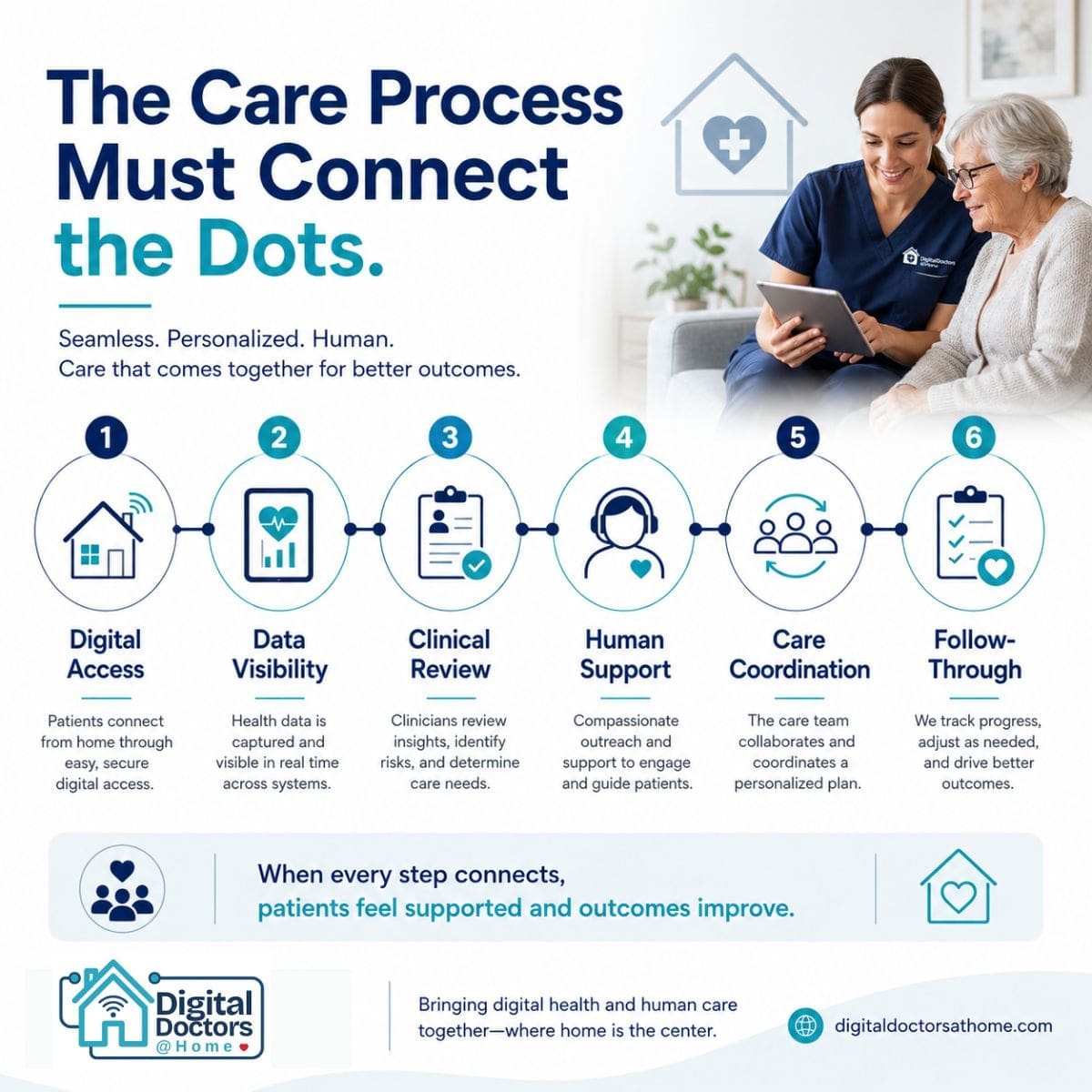
High-tech shows the care team more. High-touch helps the care team understand more—and helps the patient act on the plan.
Can Your Program Turn Digital Information into Coordinated Action?
Expanding digital access is only the first step. Government agencies and healthcare partners also need an accountable care structure that connects technology with clinical review, community support, and follow-through. Explore how the DigitalDoctors@Home Patient Care Center and home-based care model may support your program’s implementation goals.
Government Program Implementation Requires an Operating System
A government-funded care initiative may involve several organizations, technologies, professional roles, and community resources. Without a defined operating structure, each component can function while the overall care process remains fragmented.
The Agency for Healthcare Research and Quality defines care coordination as the deliberate organization of patient-care activities and information sharing among participants. Its examples include establishing responsibility, creating a proactive care plan, monitoring and follow-up, responding to changing needs, supporting self-management, and connecting patients with community resources.

Effective implementation requires answers to practical questions:
- Who owns the care process?
- Who reviews incoming information and determines urgency?
- How are concerns escalated, documented, and closed?
- How are patients and existing providers kept informed?
- Who follows unresolved tasks?
A repeatable program also needs processes for enrollment, onboarding, technology support, clinical review, communication, and quality evaluation. It must integrate with primary care providers, specialists, health plans, community organizations, and caregivers rather than create another disconnected channel.
ACCESS organizations complement existing care and provide structured clinical updates to referring clinicians. A new care partner should add capacity while remaining connected to the patient’s existing care network.
Regulatory Readiness Depends on Defined and Documented Processes
Regulatory readiness is not a single certification or technology purchase. It is an organization’s ability to understand applicable requirements and maintain the people, policies, workflows, documentation, and oversight needed to carry them out.
Depending on the program, readiness may involve professional roles, licensing and credentialing, consent, privacy and security, documentation, escalation procedures, data availability, quality measurement, reporting, and vendor oversight
A care partner cannot guarantee an agency’s compliance. It can provide verified processes, documentation, clinical oversight, and reporting capabilities that may support the agency’s broader readiness strategy.
Accountability for Public Investment Must Extend Beyond Activity
Enrollment totals, devices distributed, virtual visits completed, referrals issued, and geographic areas reached can show whether a program has been deployed. They do not, by themselves, show whether the care process worked.
A more complete evaluation asks whether significant information was reviewed, patients were reached, concerns were escalated, next actions were completed, providers received relevant updates, barriers were addressed, and outcomes were measured appropriately.
CMS’s ACCESS Model tests payments tied primarily to measurable health outcomes rather than a prescribed list of activities. It also calls for technology-supported care to be clinician-guided, accountable, coordinated, and transparent.
Not every government program will use that model. The broader lesson is that public accountability should connect activity to documented response, continuity, and appropriately measured results. Agencies should confirm that prospective partners can produce the evidence required for the specific program.
How DigitalDoctors@Home Connects High-Tech and High-Touch Care
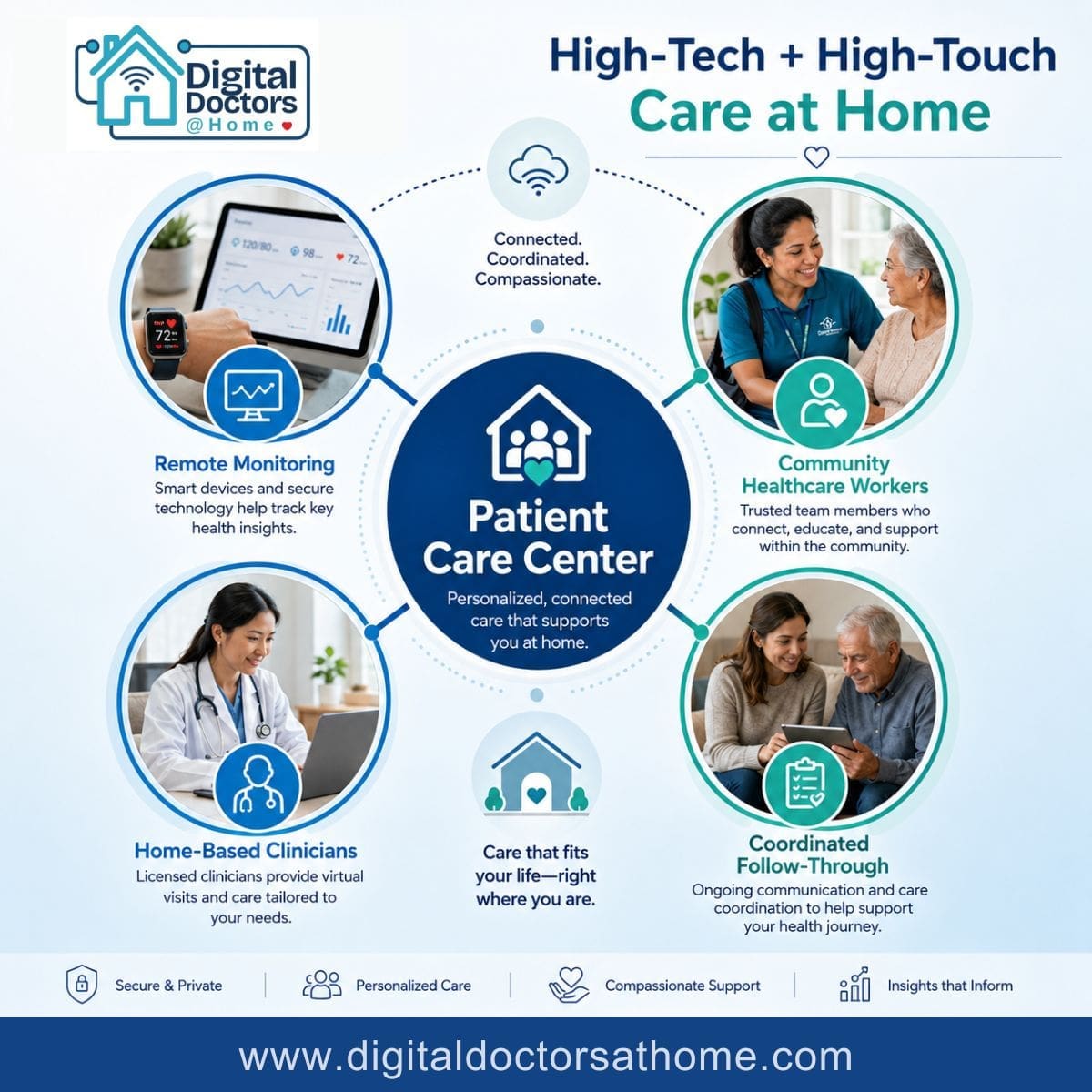
The DigitalDoctors@Home Total Care Management model combines technology with clinical and community-based support in the patient’s home. Our Patient Care Center includes nurses who monitor data and coordinate care virtually, while physicians, nurse practitioners, physician assistants, nurses, and Community Healthcare Workers provide high-touch support in patients’ homes.
Our approach considers the medical, social, environmental, and economic factors that can affect a person’s health and ability to follow a care plan.
-
The Patient Care Center
serves as a coordination hub for data review, virtual communication, and connection with the care team.
-
Remote Patient Monitoring
can extend visibility between encounters but does not replace clinical judgment, home visits, or emergency services.
-
Home-Based Clinicians
provide clinical functions distinct from Community Healthcare Worker services, home health, and nonmedical home care.
-
Community Healthcare Workers
can help identify barriers, support navigation, and keep communication moving.
-
Total Care Management
is the integrating framework intended to connect digital visibility, human engagement, clinical review, and coordinated support.
What Government Leaders Should Ask Before Selecting a Care Partner?
Before selecting a technology-supported or home-based care partner, leaders should ask:
- What population is the model designed and licensed to serve?
- Which professionals provide clinical care?
- Who reviews data and owns follow-up?
- How are concerns escalated and documented?
- How does the model coordinate with existing providers?
- How are technology and access barriers addressed?
- Which privacy, security, and data-exchange standards apply?
- What implementation and outcome measures are available?
- How are primary care, home health, home care, monitoring, and community support distinguished?
- What geographic, licensure, staffing, and operational limits apply?
These questions move evaluation beyond a service list and toward the operational discipline required to support program goals.
High-Tech Expands Reach. High-Touch Completes the Care Process.
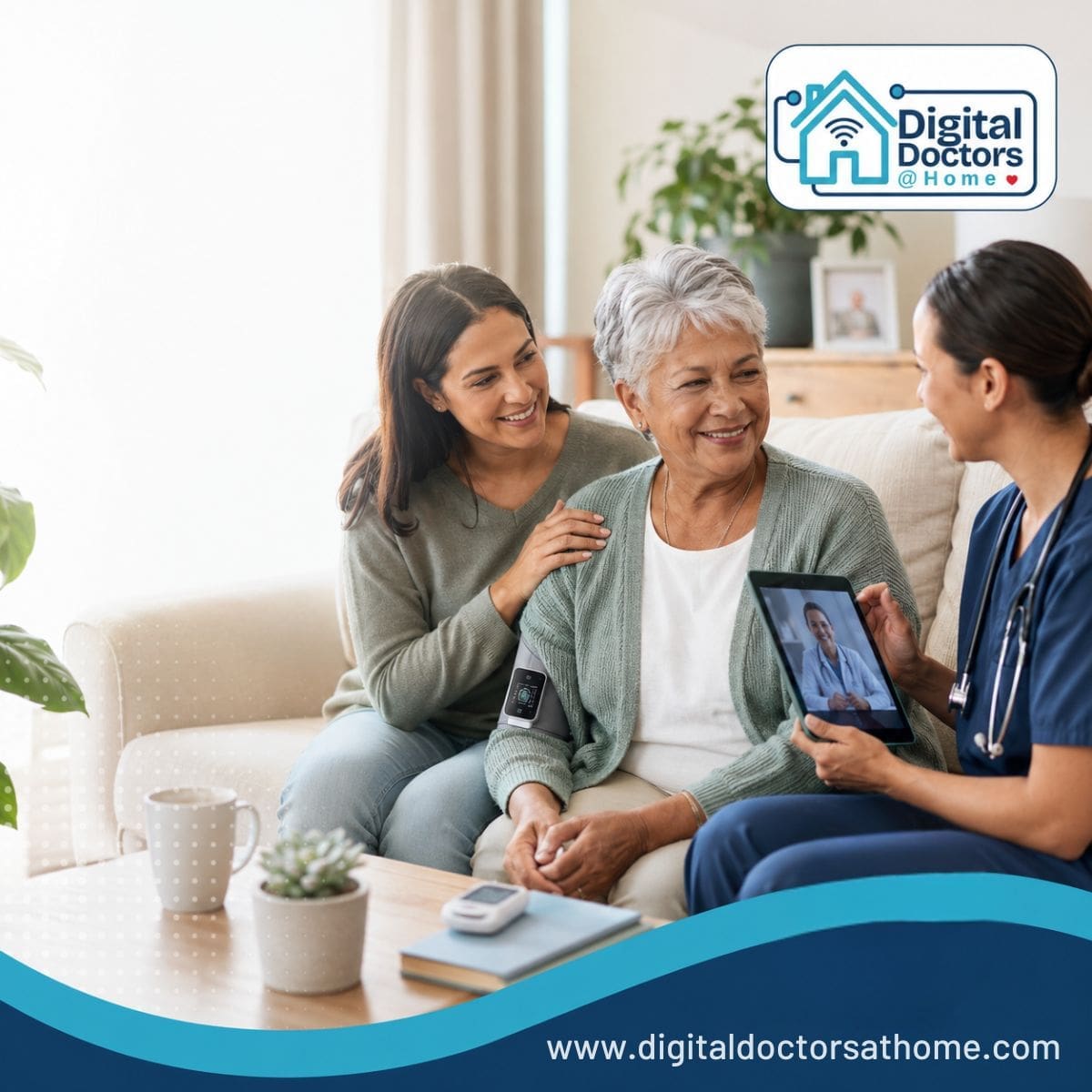
Technology can extend access, generate useful information, and improve visibility beyond the clinic. Human relationships and accountable clinical systems provide context, judgment, trust, and practical follow-through.
Government health programs need both. Public health goals cannot be fully carried out through policies, devices, portals, or isolated encounters. They require implementation models that can demonstrate not only what information was collected, but how it was reviewed, what action followed, and whether the patient remained connected to appropriate care.
For programs serving vulnerable, medically complex, rural, or community-based populations, high-tech, high-touch care offers a framework for extending public health objectives into the settings where people manage their health every day.
DigitalDoctors@Home is designed to bring those functions together through a Patient Care Center, remote monitoring, Community Healthcare Workers, virtual coordination, and home-based clinical support. For organizations serving vulnerable, medically complex, rural, or community-based populations, that structure may provide a useful foundation for a broader implementation strategy.
Explore a High-Tech, High-Touch Care Partnership
Government agencies, public health programs, healthcare organizations, and community partners need care models that can extend access while preserving clinical accountability and human connection.
DigitalDoctors@Home combines a Patient Care Center, remote monitoring, Community Healthcare Workers, virtual care, and home-based clinical support within a coordinated Total Care Management approach.
Learn More
Contact DD@H at contactus@digitaldoctorsathome.com to discuss whether this model aligns with the populations and program goals your organization serves.
Source Notes
- Centers for Medicare & Medicaid Services, ACCESS Model and ACCESS resources for primary care and referring clinicians.
- Agency for Healthcare Research and Quality, Care Coordination.
- Health Resources and Services Administration, June 2026 rural-health funding announcement.
- Centers for Disease Control and Prevention, Social Determinants of Health and Resources for Community Health Workers.
- CMS Interoperability and Prior Authorization Final Rule.
- CMS Ensuring Access to Medicaid Services Final Rule.


