Emergency department (ED) use is expensive, and some ED visits are considered preventable—often reflecting gaps in care management, access, or coordination. For medically complex seniors and high-risk adults, the pattern is familiar: a small change goes unnoticed, a medication issue snowballs, and the “safe choice” becomes a visit to the emergency room.
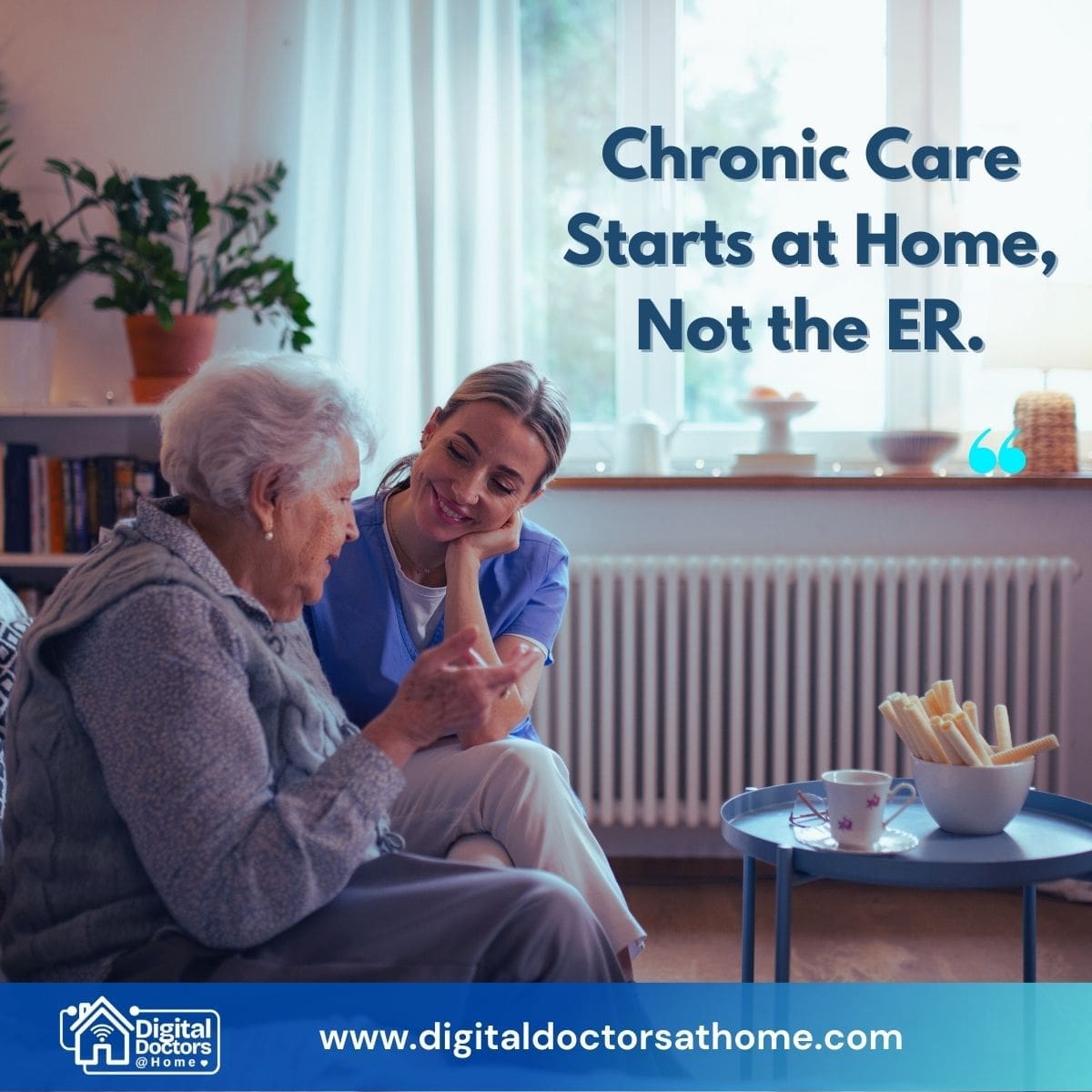
Chronic Care Management (CCM) is designed to address that gap by organizing care between visits through structured information capture, care planning, coordination, and ongoing outreach.
The DigitalDoctors@Home (DD@H) model is explicitly home-centered and combines remote patient monitoring, a virtual Patient Care Center, and a “high-touch” care team support aimed at identifying issues earlier and preventing unnecessary Emergency Room visits and hospital admissions.
What “Chronic Care Management at Home” means
In Medicare terms, CCM is a set of mostly non–face-to-face services for people with two or more chronic conditions expected to last at least 12 months (or until death) and that place them at significant risk of serious deterioration or functional decline
Centers for Medicare & Medicaid Services highlights that CCM service elements commonly include: structured recording of patient health information, maintaining comprehensive electronic care plans, managing care transitions and other care management services, and coordinating/sharing patient health information within and outside the practice.

CCM: Our Repeatable Workflow

In operational terms for medical providers, assisted living operators, clinicians, and payers, CCM at home is a repeatable workflow that answers three questions:
1) How Do We Detect Risks Early?
We don’t wait for a crisis, we look for change.
Early detection starts by establishing a baseline (conditions, meds, function, environment, caregiver supports) and keeping a living care plan.
What triggers action:
- Trend changes from monitoring data: DD@H monitors data flows to our Virtual Patient Care Center for 24/7 analysis, where AI detects patterns and predicts potential issues; early warning systems trigger clinical intervention.
- Staff/family observations: Small shifts (appetite, confusion, mobility, fatigue, shortness of breath, missed meds) reported by those who have close interaction with patients are treated as valid signals, documented, and triaged as part of ongoing care management.
- Post-change vulnerability: Follow-up during and after care transitions including discharge, medication changes, change in care.
2) Who responds and how fast?
Every signal has an owner and a next step.
According to the Centers of Medicare & Medicaid Services, patients should have 24/7 access to their care team to discuss urgent needs anytime.
One point of contact + documented protocols, allows facility staff and families to know who to call and what happens next.

Tiered urgency routing: urgent signals are handled immediately via the on-call pathway; non-urgent issues are handled with same-day/next-business-day outreach depending on severity.
Clinical oversight where it counts: Our DD@H licensed providers review AI insights and make care decisions inside the Virtual Patient Care Center workflow.
The DD@H Care team collects the data, updates the care plan, manages care and provides 24/7 access to patients.

3) How do we keep everyone aligned?
Alignment happens when the care plan is current, shared, and acted on consistently.
How alignment is maintained:
Shared care plan visibility across Primary Care Physicians, specialists, facility staff, and caregivers so changes don’t get lost between settings.
Documented interventions & updates: documenting what changed, what was done, and what to watch next, so the next clinician or operator isn’t starting from scratch.
Coordination loop: DigitalDoctors@Home provides continuous data processing, risk profiling, clinical review, and personalized action plans for our patients, creating a repeatable system instead of ad hoc communication.
Why Being Proactive in Care Matters
Proactive Care Saves Lives
The premise behind Chronic Care Management(CCM) is that proactive management can reduce downstream use of more costly care by addressing issues earlier. Centers for Medicare & Medicaid Services explicitly notes that CCM “may help avoid the need for more costly services in the future by proactively managing a patient’s health, rather than only treating severe or acute disease and illness.” (https://www.cms.gov/files/document/chroniccaremanagement.pdf, pg 5)

Research results vary by program design and population. A pilot study published in 2023 reported a statistically significant decrease in avoidable Emergency Department (ED) visit frequency after a CCM intervention in its study group. A broader systematic review of ED-visit reduction interventions (including chronic disease management-type programs) has found that effectiveness depends heavily on the intervention type and implementation. (https://pmc.ncbi.nlm.nih.gov/articles/PMC10688575)
The Building Blocks of Chronic Care Management at Home
A living care plan that’s actually usable:
CMS emphasizes comprehensive electronic care planning and prompt information sharing for effective CCM. For senior living and payer environments, the practical test is: Can the next clinician (or care team member) see the plan and act without recreating it?
Risk Visibility between visits: (RPM & clinical review, when appropriate) Between scheduled visits, DigitalDoctors@Home uses remote patient monitoring (RPM) to keep an ongoing view of a patient’s health status so care teams can spot meaningful changes sooner, not after a crisis.

Structured outreach, not call us if you need us:
Chronic Care Management is ongoing, non–face-to-face care management, with time thresholds for billing(e.g., at least 20 minutes/month for certain CMS codes), and service elements that include continuous relationship and engagement.
Care coordination as an operational discipline:
Organizing the care activities and sharing information among key stakeholders in the patient’s care helps us to achieve safer, more effective care.
In models like DD@H this means having one clear point of contact, documented handoffs, shared visibility into medication lists and care plans and scheduled follow-ups after changes.
In a home-based model, like DigitalDoctors@Home, these building blocks can look like:
- One clear point of contact
- Scheduled check-ins
- Care gap follow-up
- Documented handoffs
- Symptom review and coaching
- Caregiver support and reinforcement
- Shared visibility into medication lists and care plans
- Scheduled follow-ups after changes
What Do These Changes Mean?

For Assisted Living operators it means fewer surprise transfers through clearer signals and escalation paths.
Operators need faster recognition of change and a predictable response pathway, not more paperwork. The CCM at home model supports this by:
- clarifying what changes to report
- creating one workflow for who to call and what happens next
- tightening the feedback loop so the medical care staff isn’t left guessing.
DigitalDoctors@Home allows facilities to implement this model to help ensure their residents are healthy and have the opportunity to enjoy the amenities of being in their care.
For Patients: Better continuity of care
Patients and their families can feel confident that their Primary Care Physician, specialists, on-site care staff, clinics, etc have a current picture of their health, understand the intervention and care plans, and be ready to respond immediately when needed.
Chronic Care Management at home is most powerful when it’s treated as a consistent operating system: a living care plan, structured outreach, early risk visibility, and clean coordination loops. The Centers for Medicare & Medicaid Services supports this system because when done correctly.